After discovering (late in life) that my son and I are both on the Autism Spectrum (as well as having ADHD), I decided I had a new “calling”: to be an advocate — and translator — for my newly discovered ASD “tribe.” So I re-purposed a comic book character I’d created decades earlier, renamed him Aspie Mouse, and made him the Autistic star of a graphic novel.
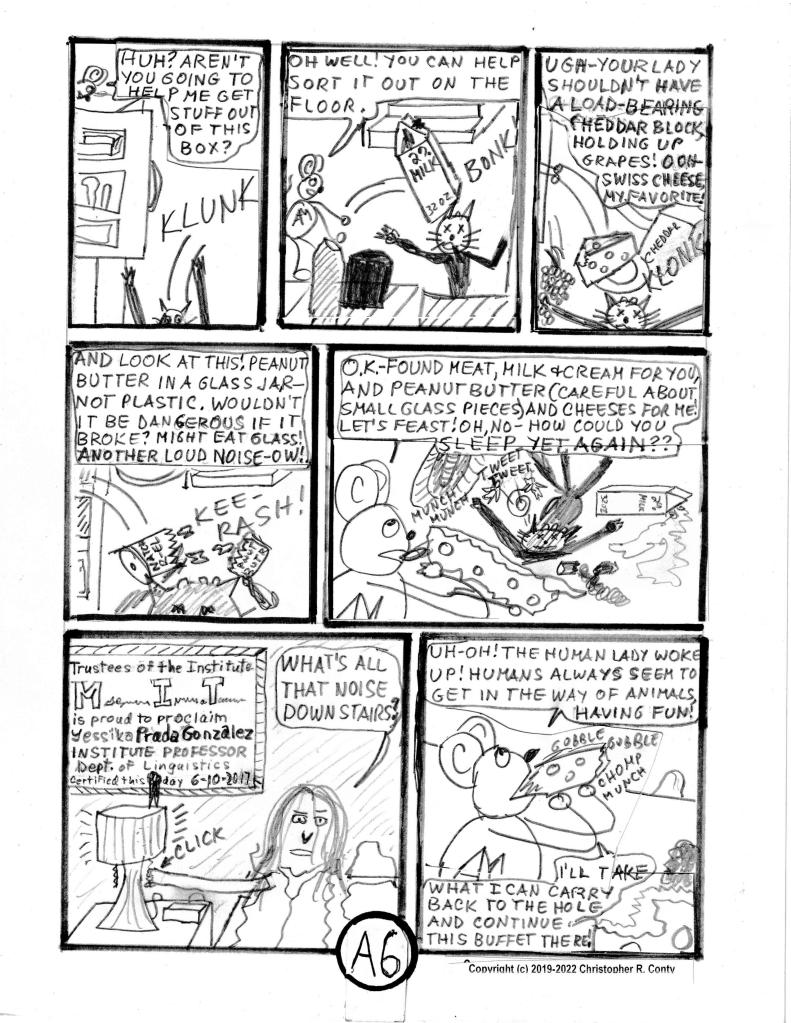
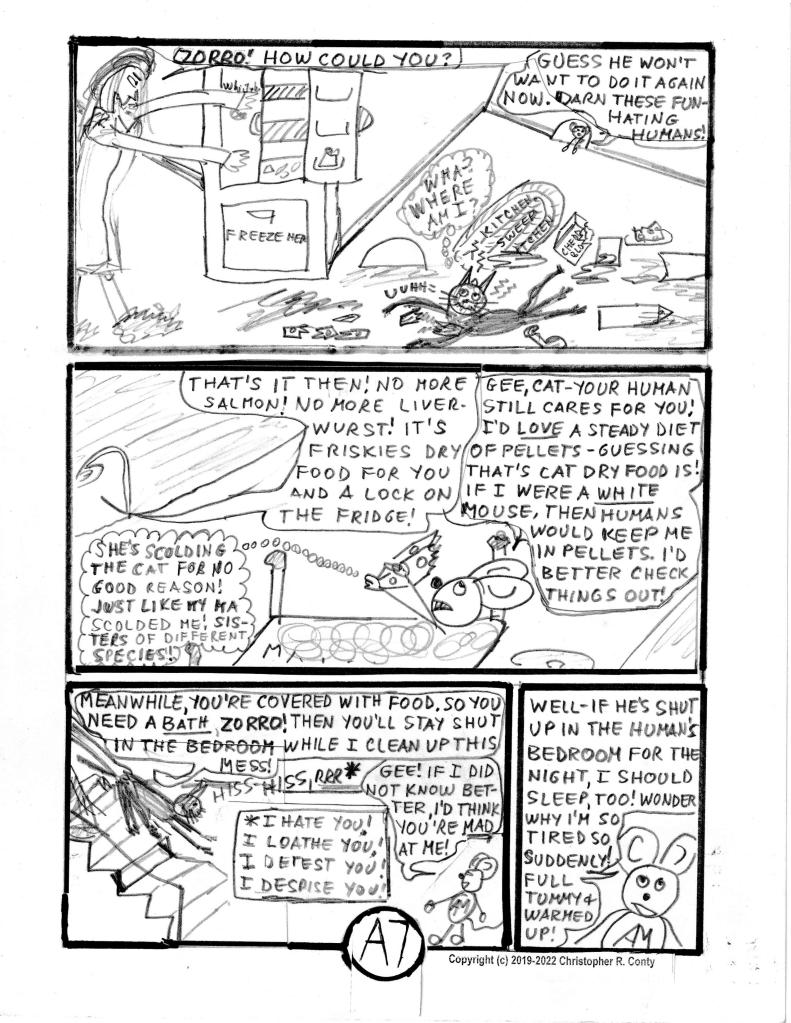
Chapter A is the first chapter I wrote after all those years of putting aside writing comic books. It’s an all-new chapter. But its plot — at least until the bottom of page 6 — is the same as if it had sprung from my Autism-fueled 12-14-year-old’s imagination. Aspie Mouse has a great time “playing” with Zorro the cat (The cat? Not so much!), in the process destroying the home’s kitchen — until the needs/ wants/ responsibilities of an adult (Neurotypical) human (Prof. Gonzalez) “ruin” it (from Aspie Mouse’s viewpoint).
Originally conceived as Chapter J — when I thought there’d be 15 chapters of roughly 10-12 pages each — then Chapter H after 10 chapters seemed more realistic as other chapters being written (Ch’s. B, C, D) kept getting longer — averaging 25 pages — as they were revised. Then an early reviewer suggested that this now Chapter H (ex-J) be moved up front to become Chapter A, due to its relative simplicity. Made sense: it was most like the 5-page chapters I wrote years earlier as a youth.
The changes that followed that decision — including duplicating this new Chapter A’s material as Chapter H with additions — which is where it belonged in the plot sequence anyway — and taking what had previously been called Ch. A and turning that into Ch. Pre-A — since it was a Preface anyway — are detailed in the notes section following the panels. Ironically, the recent decision to break these Adventures into 2 volumes — so Volume I could finally be formally published in 2024, and it could include the notes and questions for all chapters in the print version — led to adding back a new Chapter J, so each Volume would contain five “action” chapters!
In this final revision of this chapter, Aspie Mouse’s inner thoughts, emotions & feelings — separate from his near-constant chatter squeaks, which usually avoid mentioning feelings — are selectively added as thought balloons. This is how readers learn that Aspie Mouse is really more afraid, vulnerable and unsure of what he’s doing than he shows to others. Similar thought balloons are now being added for many characters — mostly, but not totally, Autistic characters — to final revisions prior to formal publication of Ch’s A-E first (Volume I).
The other change made to all chapters’ panels in this final revision is to more closely show how 27 Traits or Characteristics of Autism — as explained in the revised expanded Chapter Pre-A Preface — relate to behaviors made by Autistic characters or commented upon by other characters. Example: Ch. A & H’s last panel has the same split-screen “simultaneous words” spoken by the house human and Aspie Mouse as did the original Ch. J; however, the social interaction misunderstandings leading up to that ending — all too familiar to those with Autism — are explored more fully in an added page leading up to Ch. H’s final split-screen panel.
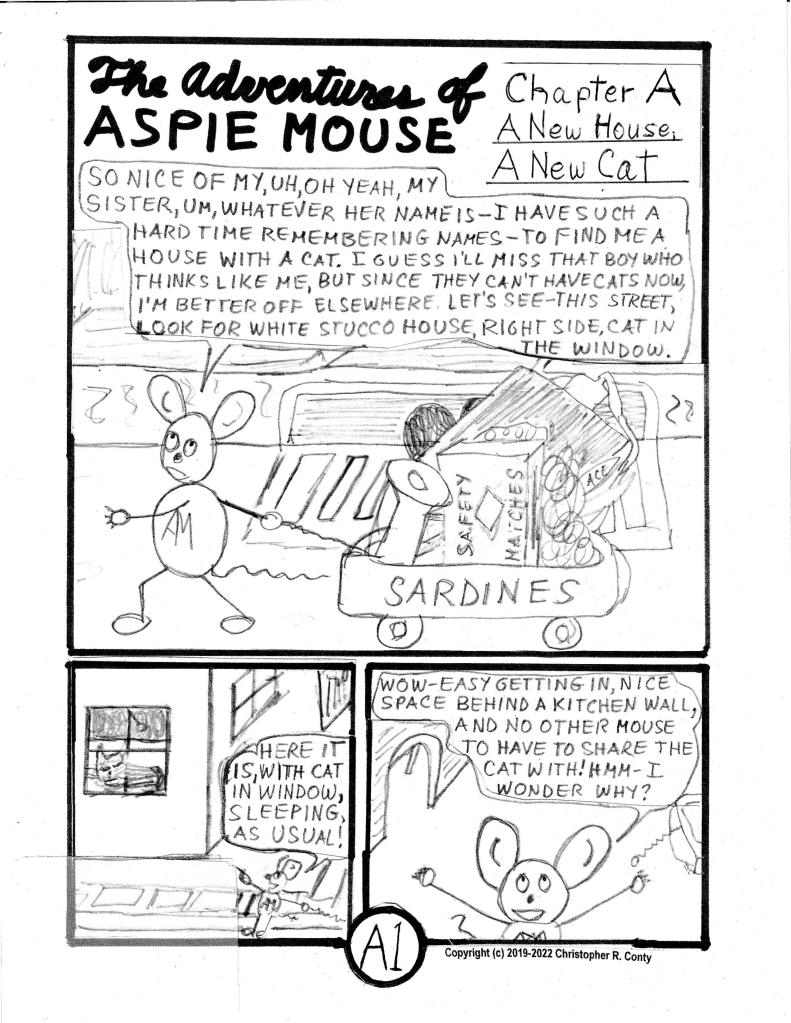

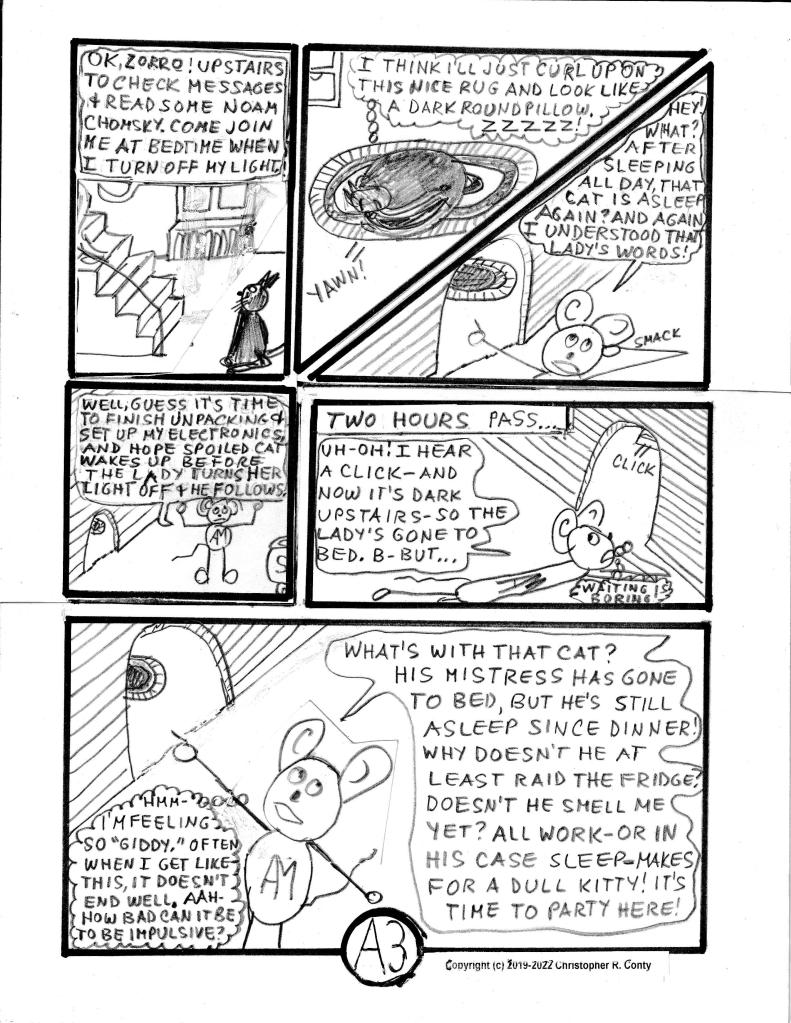
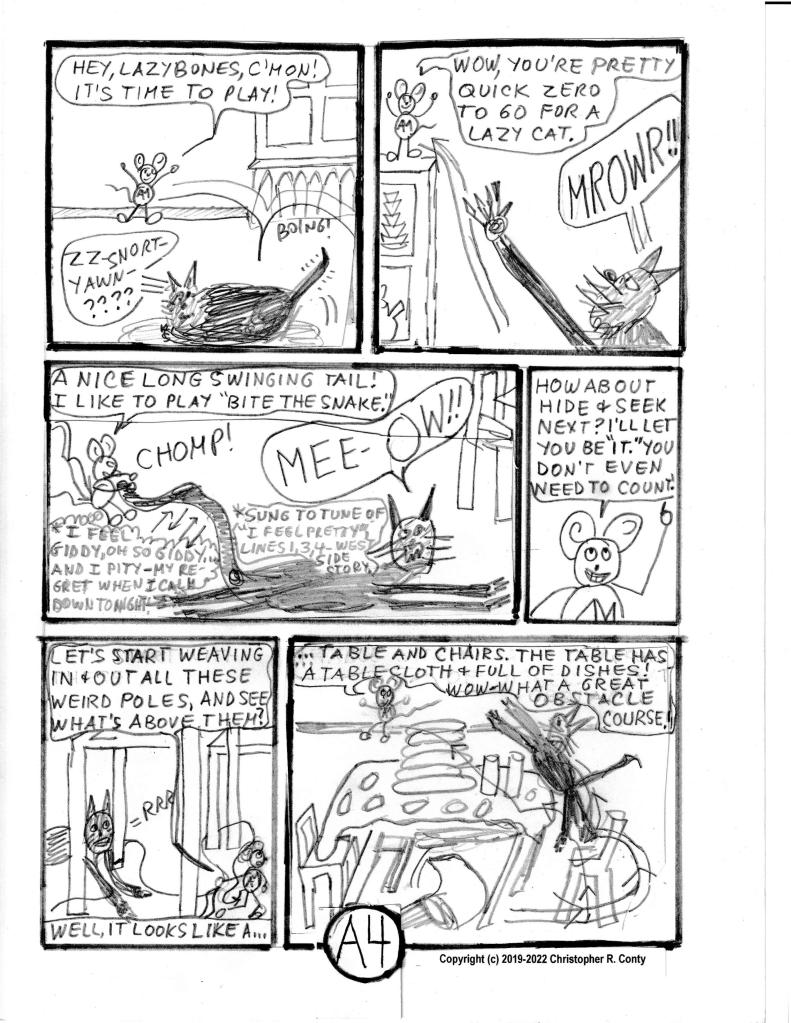
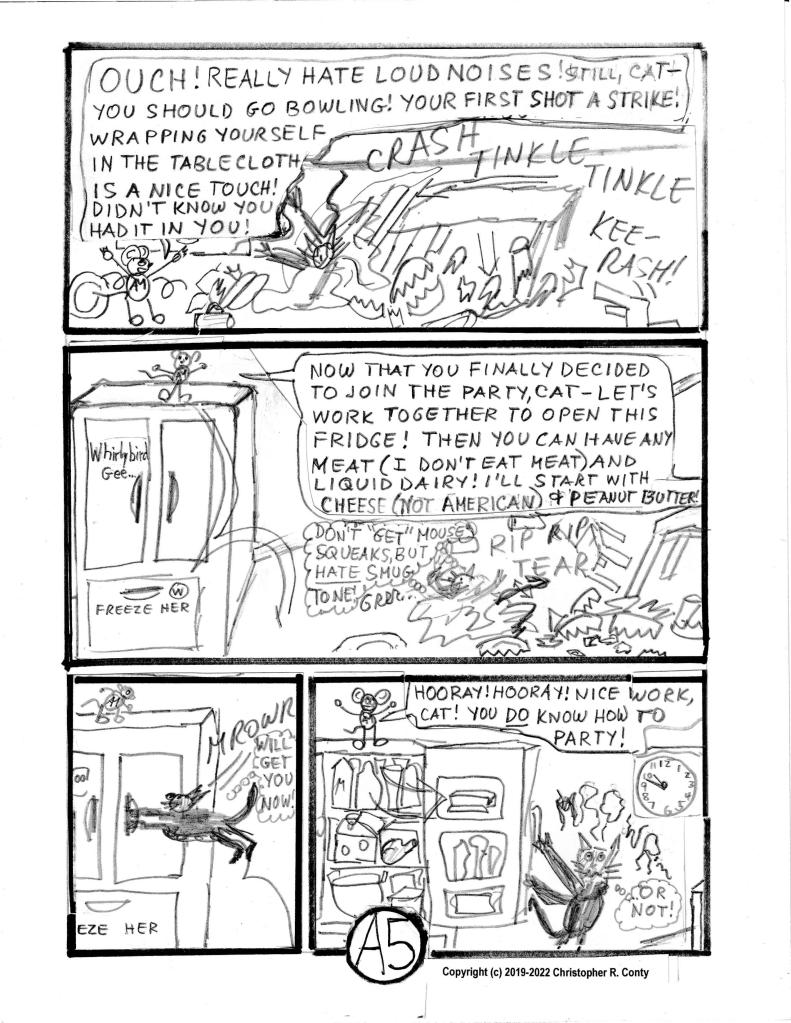

Author’s Note: I’m choosing to use first person voice for chapter notes, after first trying third person; it got too awkward! By using “I” statements — which many consciousness-raising programs teach people to do — I get to “own” the responsibility for the words I use. This makes sharing my own Autistic experiences in the notes — as well as those of my son, late mother and numerous other relatives and friends who fit the profile of ASD — easier and more natural. Questions will remain in third person.
Notes for Chapter A, A New House, A New Cat
After discovering (late in life) that my son and I are both on the Autism Spectrum (as well as having ADHD), I decided I had a new “calling”: to be an advocate — and translator — for my newly discovered ASD “tribe.” So I re-purposed a comic book character I’d created decades earlier, renamed him Aspie Mouse, and made him the Autistic star of a graphic novel.
Chapter A is the first chapter I wrote all those years after putting aside writing about Aspie Mouse’s predecessor Stupid Mouse. It’s an all-new chapter, but its plot — at least until the bottom of page 6, when the homeowner, Prof. Gonzalez, wakes up hearing all the commotion — is similar to those created from my Autism-fueled 12-14-year-old’s imagination. Its Autism-specific “lessons” as to how Autistic traits can be seen positively are more limited vs. later chapters — because tying the traits Autistic characters display during these Adventures to 27 characteristics of Autism wasn’t part of the original plan — though Aspie Mouse’s Autistic traits are quite evident from the get-go.
While first written, this chapter was originally intended to be a later chapter, originally Ch. J when I envisioned this graphic novel having 15 chapters averaging 15 pages each. As Chapters B, C & D were developed — each adding pages with every rewrite (while this first chapter was put aside) — and the average length of chapters increased to 25, I decided to limit the total number of chapters to 10, and re-letter Ch. J as Ch. H. Then — while Ch’s. E, F, G and I were being blocked out, a reviewer suggested that this put-aside first written chapter would make an ideal FIRST chapter, because it’s relatively straight-forward and has more action than words compared to other chapters: it’s primarily the story of Aspie Mouse trying to get a cat to “play” with him and the unintended consequences that follow. I agreed, but that required other changes.
To avoid re-lettering the subsequent chapters, I turned then Chapter A — a preface pretending to be a chapter — into Ch. Pre-A. Since the events of what’s now Ch. A were “out of sequence” in the flow of this graphic novel (like starting a novel or movie with a middle scene, then flashing back), I chose to repeat Ch. A’s material as Chapter H (in Volume II), where it belongs in the plot, falling between Ch’s. G & I. A new sub-plot covering social class, bullying and “race” among rodents doubles Ch. H’s length compared to Ch. A, making the Ch. A material worth re-reading in its new context.
Chapter A was put aside again once Ch’s. A & H were broken out and revised together, so the remaining chapters through Ch. I could be completed. Once they were, and all chapters’ notes and questions were created and updated, I decided three final upgrades were necessary:
- Tying in 27 common characteristics of Autism to the positive benefits of Autistic behavior in every chapter (including a spreadsheet of Autistic behaviors and each chapter’s major characters).
- Adding characters’ thought balloons (especially Autistic characters) when their feelings/ motivations differ from what they’re saying.
- To assure publication in 2024 after delays adding the two changes above, the work is now split into two volumes, Ch. Pre-A to E in Vol. I, and Ch. F to J in Vol. II. The new Ch. J adds two new mouse characters who manifest Autism differently from those in prior chapters (ironic, in that Ch. A was once Ch. J!).
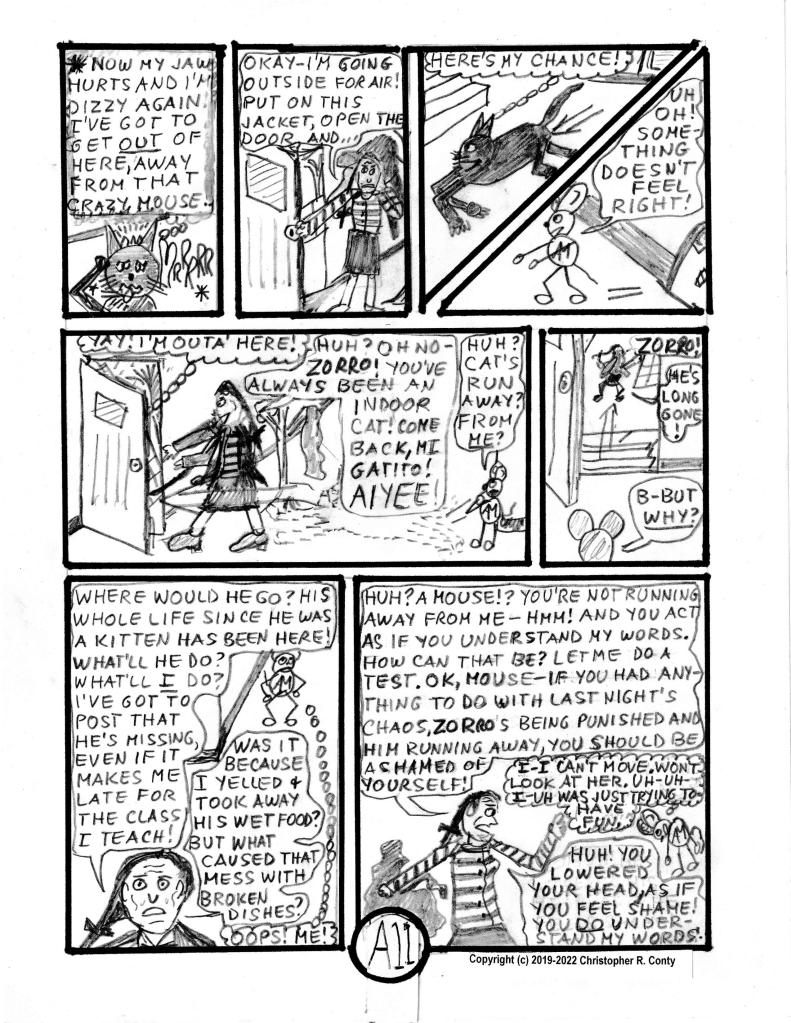
Chapter Synopsis: Aspie Mouse, having to leave his former house (why is explained at the end of Chapter G in Volume II), finds this new house to his liking: it has a cat and no other mice. Since Aspie Mouse’s favorite pastime is “playing with cats,” he’s eager to engage the new house’s cat once he’s settled in. The chase that follows is fun for Aspie Mouse, but it’s quite destructive to the home’s kitchen, and no fun at all for Zorro the cat — who not only gets repeatedly humiliated and bonked on the head, but gets blamed by the homeowner, an older Prof. Yessika Gonzalez. The cat is so hurt — emotionally and physically — that when he has a chance, he escapes outside. The chapter ends with Professor Gonzalez scolding Aspie Mouse, while surprised that the mouse indicates that he understands what she’s saying!
Specific Characteristics of Autism Introduced in this Chapter:
Chapter A may offer fewer significant “lessons” for those with Autism than the chapters that follow, yet many (most?) of Aspie Mouse’s Autistic behaviors show up right away.
For example, because he has difficulty associating names with faces and/ or reading body language (Trait #23), he can’t recall his sister’s name. Also, he’s glad to be the only mouse in the house, rather than having buddies around to hang out with — so like most Autistic folks, he’s a loner. Being an independent thinker, with weak peer influence and a need to work independently (Trait #11), Aspie Mouse thrives while being alone most of the time. For most Neurotypicals, being alone for long periods of time would result in panic or depression. However, Ch’s. D & E show how even a loner wants some same species contact at times.
Then there’s Aspie Mouse’s special interest (Trait #10) of playing with cats. Clearly he’s poorly “tuned in” to mouse social norms (Trait #8) — or species survival instincts really! Cats chase and kill mice! Mice don’t ask cats to play with them! Then there’s Aspie Mouse’s special interest (Trait #10) of playing with cats. He gets away with it only because he behaves and responds “unexpectedly” (Trait #11 again)!
Another Autistic trait that shows up during the initial “play” episode (pp. A 4-7) is Aspie Mouse’s sensory sensitivity (Trait #2): he reacts strongly to loud noises. And of course, as we see right away, he looks up, rather than at anyone else (Trait #1, No eye contact).
More important to functioning in the world is his poor (or no) understanding of the motivations and reactions of others to his words or actions — Trait #8, It’s Lack of social understanding again, but even more Trait #17, being unaware of the impact one is having on others— which occurs over and over again in this work. The technical health professional term is that Aspie Mouse has a deficit in “theory of mind“: that is, difficulty (or even inability) to put oneself in another person’s shoes/ to see things from another person’s perspective.
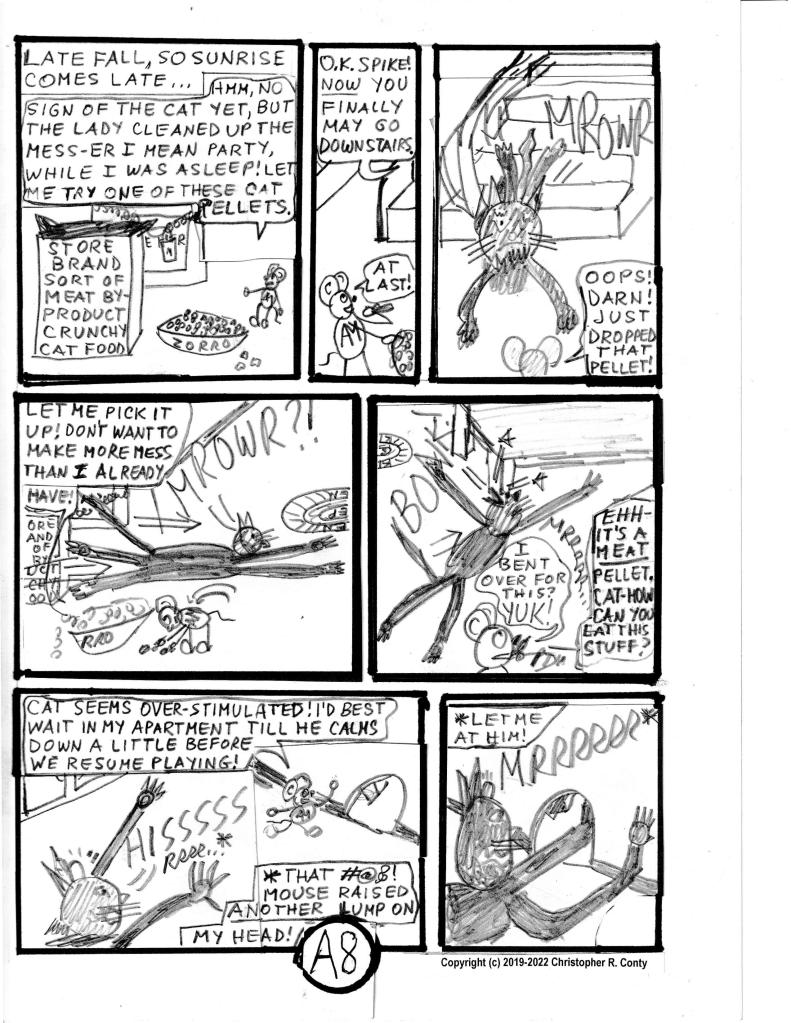
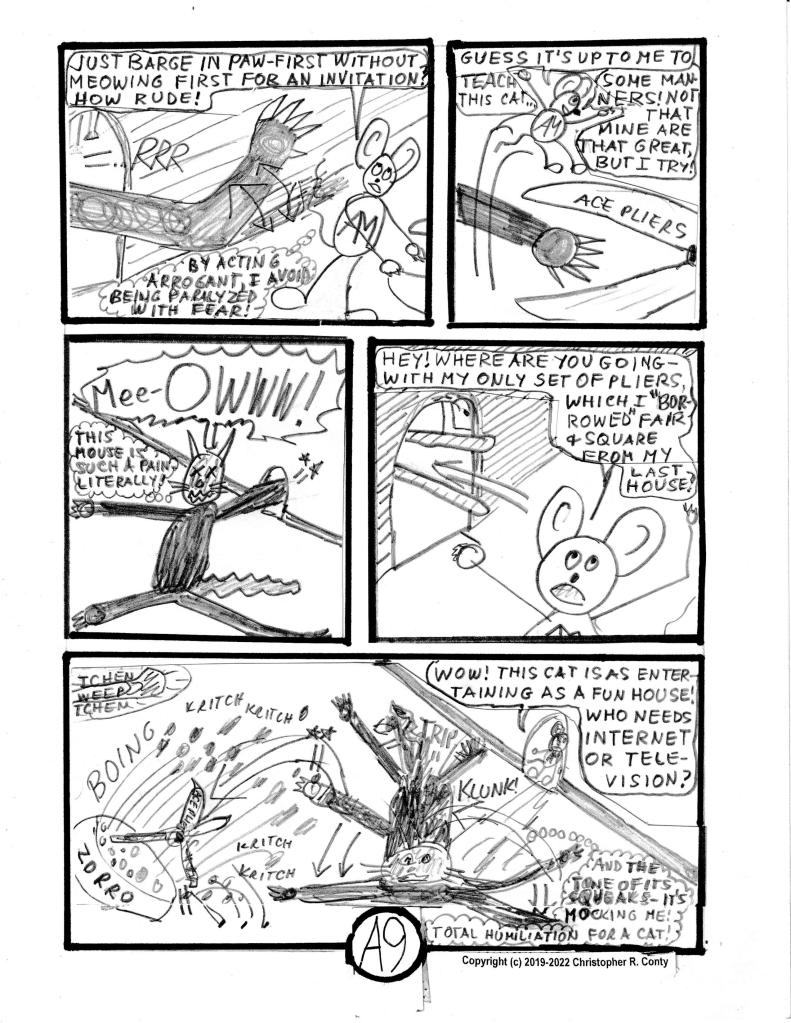
Examples: (1) Aspie Mouse thinks Zorro the cat is “playing” with him, when Zorro’s just trying to do his job — get rid of the mouse; (2) he’s oblivious that he’s hitting Zorro on the head as he throws food out of the refrigerator; (3) later, he’s unaware he’s bonked Zorro again on the head, this time while taking back a pair of pliers; (4) he completely misreads Zorro’s body language when his human homeowner drags him upstairs — or actually, at any time; (5) he also pays no attention to Prof. Gonzalez’s needs and wants — assuming she just wants to thwart him from having fun because in his mind that’s what grown-up humans do! And of course, it’s these “misunderstandings” of others’ reasons for doing what they do that make Aspie Mouse’s responses engaging and funny. For most of those with Autism, the consequences aren’t so funny.
Yes, Autism is a “syndrome” made up of many traits viewed together. However, lack of social understanding, in the broader sense of not understanding the rules people (or in this graphic novel, also animals) have learned to play by — without intending to cause others harm or inconvenience — may be the best predictor of someone on the Autism Spectrum or not. Most of this graphic novel’s “lessons” — and its question sets (following these notes) — focus on this combination of lack of social understanding and difficulty taking another’s point of view and how often other Autistic traits tie back into them. Add in anxiety and its consequences (see below and in subsequent chapters) and these traits can feed each other, making things worse.
Difficulty taking another’s point of view is not limited to those with Autism. A Psycho/ socio-path has no interest in caring when their victim is writhing in pain (physical or psychological). Many personality types of people can be selfish — such as when a car driver cuts another driver off. In some societies — like Japan — social pressure to conform is so strong that their Neurotypicals often don’t develop a personal moral compass: when someone in such a society believes they won’t get noticed doing a personally beneficial but socially taboo behavior, they’re more likely to do it. Note they’re very aware what the social understandings are. But when difficulty taking another’s perspective is part of lack of social understanding, it’s likely an Autism marker.
Those with Autism get in trouble with this, because they’re told their behavior is “selfish,” “intentionally trying to hurt others,” “acting stupid” or even being a “narcissist!” These accusations can be devastating: feeding low self-esteem; raising anxiety; causing confusion and can shut down the person so accused (freeze. the most common response to anxiety) — potentially leading to depression. Truth is, an Autistic person rarely hurts others — physically, socially, emotionally — on purpose; it’s done out of ignorance, anxiety, confusion, etc. If you’re accused of being an “extreme narcissist” because you have trouble taking an other’s point of view, and you wonder if you ARE, odds are you are Autistic, and NOT a narcissist — or a psychopath or sociopath. These anti-social personality types would ignore the comment, feel no empathy, and seek some way of retaliating against the accuser. The Autistic person, on the other hand, usually feels terrible, doesn’t know how to remedy the situation, and may be feeling (maybe not identifying) grief and sadness. It’s these more positive aspects of Autism (empathy, truth-telling, etc.) that this graphic novel emphasizes — including those within traits usually viewed negatively. The positive parts are often overlooked, because to a cynical Neurotypical, the “Polly-anna” attitude of an Autistic person seems too good to be true, yet it may well be true! Chapters C & D show the contrast between Autism and psychopaths/ sociopaths, etc. more clearly.
Those with Autism usually rate anxiety, resistance to change and low self-esteem as more common problems than lack of social understanding or not taking another’s point of view. We’ll cover anxiety heavily in subsequent chapters. The first three traits are internal states that can’t easily be seen or measured, whereas the other two are observable by others. As with other traits, those with ASD vary as to how confused or clueless they are in social situations. Also, some social situations cause more problems than others.
In this graphic novel, Aspie Mouse is portrayed as way over on the “clueless” end of the spectrum, because that allows readers struggling with this issue to see Aspie Mouse’s cluelessness as way over the top, vs. the reader’s own. Thus each chapter in this work offers an opportunity to discuss how things might be different if Aspie Mouse were more aware of social conventions that he — despite having a strong moral compass and being seen/ seeing himself as a good rule follower (his rules, not mouse society’s) with good intentions — keeps violating social expectations without realizing it. This is apparent early on in Ch. A (as noted above), and continues to the chapter’s end, when Aspie Mouse finally learns the impact that his lack of social understanding has on others (Prof. Gonzalez & Zorro the cat) — and its resulting consequences for him! The contrast between intention and impact is this Author’s biggest problem, and in my observation, a big problem for most with Autism! It’s led to me getting as much feedback as possible from others so I learn what my impact is.
At the end of Ch. A, Aspie Mouse is confronted by Prof. Gonzalez (the lady homeowner) with the truth about the pain his actions — resulting in Zorro running away from home — have caused her and Zorro (the basis of Question Set #A.8). It reflects my own (the author’s) experience of having something trigger my anxiety such that it ramps way up — often unaware it’s so elevated — and then “do something” impulsive to lower that anxiety temporarily, unaware that longer term I’m causing unintended harm to others — and to myself. I now realize that the life-long pain I’ve experienced — and caused — by my “act first, think later” response to an anxiety spike trigger is my #1 motivation for doing this graphic novel, by resurrecting a comic book character I’d created at age 12 for two years and then abandoned for decades. Unaware of the impact of my words/ behaviors had on others until after it was too late to undo, I’d then feel awful when the impact was pointed out. I’d ignored likely consequences on others. My actions created mistrust/ chaos. They cost me jobs, relationships & opportunities. People would be angry with me, not trust me, and exclude me from desired activities.
What Aspie Mouse and I both believe in these situations is that others’ motives, actions and sensitivities are a lot like our own — assuming we even consider their point of view at all! Clinically, we’re both so anxious, our “executive function” gets overloaded and — this is where we get in real trouble — it looks to others as if we don’t care. In a Neurotypical’s mind, how could we NOT care? We’re obviously not stupid, yet we’re being socially blind, even socially stupid. The accusations (to us, they seem to come out of nowhere) are that we’re outrageous & insensitive; we cause chaos & disruption, and we/ I can’t be trusted. It’s not that we’re too insensitive, but rather we’re too sensitive! Yet, in that moment we can’t access resources that would cause us to stop and think instead of acting. This is also known as “Emotional dysregulation.” The response is shame (“Oh no, I’ve done it again! What’s wrong with me?”). My “flight” would be thoughts of becoming a light-house keeper, because clearly (I told myself) I wasn’t fit to be in the company of others. As an extrovert, I’d be miserable doing that! It reflects the repeated shame of realizing how my “blurting out” behavior would happen again and again; I seemed to have no control over it, and the result? Self-sabotage!
If you’re an Autistic person who behaves the way I’ve just described or supervising one, it may be worth spending some time on this issue during Chapter A — including why Aspie Mouse seems to find it easier to “get away with” this behavior than others do. The key to my “recovery” and regaining lost trust is to ASK FOR FEEDBACK — preferably ahead of time — the next time I think others would react to hearing the weirder thoughts of my mind the way I do, “No big deal.” Instead, they are likely to say something like, “Aah! How could you SAY that?” So now I take in all feedback graciously. Also, I don’t take things (so) personally; instead I see this feedback as a growth opportunity. Do I think a child or adolescent with Autism can be trained to think this way? Maybe using behavior therapy (CBT, DBT), but it took years of personal growth work as an older man for me to begin to make a dent in this self-sabotaging behavior.
Finally, about names. For Aspie Mouse’s name, see Chapter Pre-A (the Preface). As for more of the rationale I use in naming people and identifying their ethnicity, see the notes for Ch. C.
Professor Yessika Prada Gonzalez (also in Ch’s. H. I & probably J) is intentionally an immigrant, because as a linguistics professor, it was important for her career — and useful for the plot of this graphic novel as per Question — to learn to speak English (her second language) with both unusual clarity and a definite accent. She’s Hispanic in honor of three Hispanic/ Latinx women I know or knew personally, each of whom I honor by giving the Professor one of each of their names. Yessika — how “Jessica” is spelled in Spanish — honors the first name of one former beloved Colombian au pair. Prada honors the last name of our other well-loved Colombian au pair. Gonzalez was the maiden name of Peter’s (one of my best friends’) mother — my mother’s best friend — though she switched back to Basoa (also of Spain) after two divorces, disliking how she was treated as a Gonzalez growing up in NYC.
As for the cat’s name, Zorro: It’s the name of a fictional “Spanish Robin Hood” in Mexican-held Los Angeles in the early 19th Century. Written by Johnston McCullers and turned into a popular TV series by Walt Disney in the late 1950’s, Zorro has seen revivals in movies and another TV series in the 1990’s. No recent Zorro has come out as of this writing, but apparently Disney is working on one. Good! I absolutely loved the old TV show, and back then it was about the only TV program featuring a Latino (except Desi Arnaz on “I Love Lucy” reruns and Bill Dana as Jose Jimenez on Ed Sullivan’s variety show). Readers unfamiliar with Zorro may want to look him up and find out why Aspie Mouse repeats the theme of Zorro as “… the fox so cunning and free,” and find out why Zorro could be an appropriate name for a cat, even though foxes are classified as canines (dogs). Aspie Mouse is clear that dogs aren’t cats at the point of the graphic novel where this chapter belongs (as Chapter H), but is clueless in Ch’s B-E.
Now for notes specific to the plot and panels of Chapter A and the Questions that follow:
Questions that follow these notes (from A.1-A.4 & A.7) are intended to have students reflect on Aspie Mouse’s Autistic traits, and how the actions he takes based on these traits in this chapter are beneficial to his well-being and which are not. Question Set A-1 (and then B-1, C-1, etc.) involves an ExcelTM spreadsheet tying each of the primary characters in the chapter — animal and human — to the 27 common Characteristics of Autism introduced in Ch. Pre-A, the Preface. It’ll be easy to fill in the traits for Aspie Mouse for someone who reads the above general and topical notes, because specific traits displayed are referenced by both name and number.
Question A.2 discusses physical traits commonly associated with Autism, such as reading body language and facial expressions. On the other hand, A.3-A.4 emphasize in various ways the “lack of social understanding/ difficulty taking another’s point of view” combination. Readers are also asked in all questions as to how and when their own response behaviors have gotten them in difficulty; if they notice a “spiking in anxiety” when that occurs; and what techniques they may use to have the same confident sense of well-being that Aspie Mouse often feels while he’s interacting with the cat, or the human — and whether Aspie Mouse’s confidence is based more on good self-esteem or ignorance.
Let’s look more closely at Question Sets A.3 & 4: A.3 focuses on why Aspie Mouse chooses actions that cause trouble or even physical harm (Is he intentionally trying to hurt Zorro the cat or get Zorro in trouble?): and then asks whether or not the reader can identify with Aspie Mouse, and if yes, come up with examples of being in similar situations. By contrast, Question set #A.4 delves into how Aspie Mouse’s other Autistic behaviors impact Zorro the cat, and challenge the reader to take Zorro’s point of view, not just Aspie Mouse’s.
Question Set A.4-1 addresses the “speech” side (or in this case, “squeak” side) of Autism. As we see, Aspie Mouse is constantly chattering and thinking of additional things, whether he’s alone or interacting with Zorro. He talks to Zorro, even though Zorro can’t understand his squeaks. Constant chattering — including dominating while speaking, making unexpected grunts and noises, and asking lots of questions — is one side of Autism, and fairly common, though not the image most people have of Autism. This is how Aspie Mouse — and this Author — is. In later chapters (Ch. E, F & especially I & J), other Autistic characters will mostly be silent (at least initially), the more familiar side of Autism.
Question A.4-2 addresses what is described as “picky eating,” even though that’s common to many non-Autistic children, and maybe a few non-Autistic adults. But the second half of the question — asking about eating the same foods day after day without going crazy — is when a combination of valuing routine, sensory sensitivity (to smells, taste, etc.), putting low priority on necessary bodily functions such as eating, sleeping, etc., mark such behavior as probably Autistic, especially if it’s accompanied by other Autistic traits. My Asperger’s level grandfather would take my grandmother (who I’m pretty sure also had ASD, but not as extreme) out for Valentine’s Day to the same downtown Chicago restaurant year after year, and always ordered the same food. Also, teaching my teenage son to clean up after eating is challenged by his difficulty in not barfing when opening the fridge or the garbage can due to sensory sensitivity to strong smells!
Question A.4-3 concerns jealousy. Jealousy is not an Autistic trait; it’s present in most (all?) humans. However, in a family with an Autistic child, that judgment or feeling (maybe some of each?) may come up more often, due to unequal — even if fair — treatment: maybe the Neurotypical sibling is jealous over the extra attention the Autistic child is getting; and maybe the Autistic child is jealous — wanting to please their parents, too — but it seems a lot harder to “meet their expectations” than for the Neurotypical child. In fact, most things — schoolwork, making friends, obeying rules — seem a lot harder for the Autistic child to master, so there are often fewer accomplishments to reward.
Questions A.6 & A.8 are about Prof. Gonzalez, the lady homeowner, and her interactions with Zorro (A.6) and Aspie Mouse (A.8). A.6 questions aren’t really about Autistic characters, since neither Zorro nor his human housemate have many Aspie traits. But they do address issues around punishment, believing in others, loyalty, etc.
Question A.7 addresses attitudes about play. Should adults play? Do they? Do you (the reader)? What’s appropriate at what ages? One of the hardest things to accomplish with an Autistic child, adolescent or (even) adult is switching them from a favored play-oriented activity — such as computer gaming — to a less-favored, more “adult” activity. However, one of the most charming aspects of someone with Autism may well be their continuing love of play, and totally discouraging it may make that person’s life a drag! This author got through the early part of the pandemic by spending a lot of time putting these chapter’s panels together, and regretting having “given up” cartooning in high school just because I couldn’t see a way to make a living from it. There’s more to life than making a living! Play will come up again as a topic in subsequent chapters (especially Ch. E).
Question Set #A.8 refers to Prof. Gonzalez’s confrontation of Aspie Mouse at the end of the chapter, after Zorro has fled in terror. Near the end of the chapter notes above are three paragraphs devoted to how Aspie Mouse (and the Author) engage in actions that seemingly ignore social understandings, ignore others’ perspective, and cause disruption and chaos without meaning to, so no need to rehash that here.
Let’s look at the confrontation Prof. Gonzalez has with Aspie Mouse from other perspectives. The professor is surprised Aspie Mouse seems to understand what she’s saying to him. Why Aspie Mouse understands her speech — but not that of other humans — is a mystery that Question A.5 asks, but is best answered when asked again as Question H.6 — after the reader has read the other chapters through Ch. H, particularly Ch. B. It requires some intuitive thinking and creative problem-solving, because it’s not spelled out — even here in these notes.
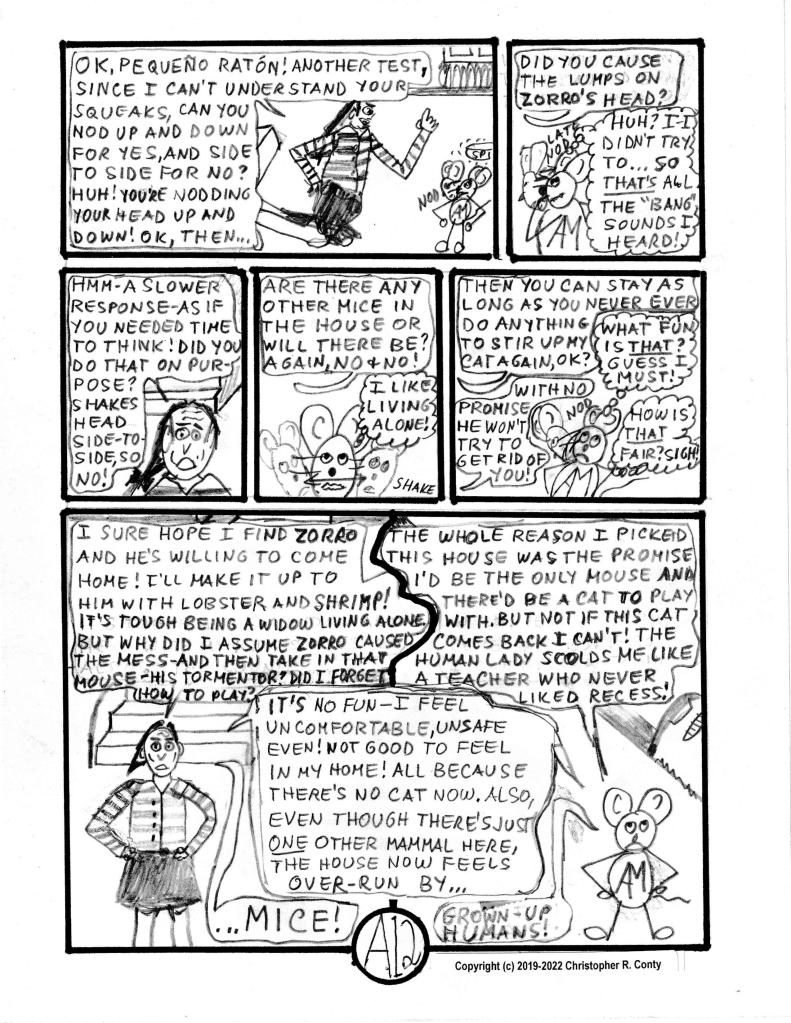
Aspie Mouse’s response to Prof. Gonzalez’s scolding (Question Set #A.8 2-4),is not to run away, but instead lowers his head in shame, then shake his head yes and no in answer to her questions. This probably is an unexpected response sequence from anyone (any-un?) Autistic — but especially a mouse. It would be more expected from a Neurotypical human. Since Aspie Mouse responded this way, the professor was able to trust him. Why this response? Because if Aspie Mouse gave her a more typically Autistic response — either running away or (even more likely) frozen with anxiety and thus keeping his head still (neither lowering it in shame nor nodding yes or no), even if he understood every word she said — it would make moving the plot forward more difficult. The widespread absence of common social gestures (such as nodding and shaking one’s head) to show feelings such as shame/ remorse is a key reason it’s hard for Neurotypicals to trust the “quiet” Autistic folks (“What’s the matter? Don’t you feel anything?” they may be asked; it may be true for some; for others, feelings could be strong if measured by a brain or heart monitor, but just be able to show a frozen facial expression).
Except for his head movements, Aspie Mouse responds in ways often associated with Autism: he doesn’t look at the lady human; his facial expression is rigid; and he doesn’t run away — he freezes — the most common Autistic response to anxiety-provoking situations (vs. flight, fight or fawning, See Ch. B notes, where Anxiety starts being covered extensively and will continue thereafter).
Chapter A Questions for Thought and Reflection for A New House, A New Cat
27 Common Autism Characteristics, followed by possible questions related to Ch. A:
- No eye contact
- Sensory sensitivity: noise, certain lights, smells, touch/ textures, foods, hunger/ bathroom needs; physical space (stand too close/ far from others; need escape); creative, passionate re art, music, touch
- Self-Regulation: Speech: voice volume, repetition & variability; amount (see #6)
- Self-Regulation: Stimming – flapping, swaying, repetitive body/ hand movements/ head banging; use “fidgets”
- Anxiety (fear) & Overwhelm. Executive Function closes up > Meltdown: fight, flight or freeze. #1 barrier to ASD good mental health. Key: lower anxiety — yoga, meditation, count to 10, positive self-talk.
- All-or-None Thinking & Behavior: Say too much/ ask too many questions or say/ ask nothing; flat affect or too dramatic; not show or over-express feelings (see #7); avoid people or obsessed w/ some; loves/ overuses puns or humorless; substance abuser or teetotaler — extremes, no gray. Learn to sit in discomfort, seek middle.
- Difficulty identifying feelings; then not show or over-express them. Mistake not showing for not feeling & over-showing for “acting/ exaggerating.” Learn core feelings (mad, glad, sad, scared) & “not about me”
- Lack of Social Understanding, of others’ expectations (unaware). Ask for rules, put in writing and study as if taking school test. The core trait that drives the Adventures of Aspie Mouse: why his choices makes one laugh.
- Pattern-seeking/ solving problems in unique ways: why they’re inventors, good at “detail oriented” jobs; creative, intuitive.
- Special Interest(s) can pay off having unique expertise for work/ hobby. Great for self-esteem, relaxing, lowering anxiety.
- Independent thinkers/ most inventors; no/ weak peer influence/ expectations. Also a need to work independently as a colleague, not in a team structure. Needs trusting boss!
- Persistence once fully engaged; terrifying level of energy; not easily re-directed (see #16).
- Self-entertaining: If access to special interests, never bored; needs no playmate.
- Rule follower: conscientious once buys in; then helps enforce rules, offers improvements.
- Honesty, innocence, naivete: unusually truthful, will even tell on oneself. Positive side of “lack of social understanding” (see #8). Leads to trust, but seems too good to be true.
- Love routine/ dislike change and transitions: helps in self-regulation; holds on; loyal, slow to adjust, won’t jump ship.
- Unaware of impact of actions on others (adds to friction from #8): so invite feedback, don’t explain yourself.
- More logical than emotional: Makes for discomfort – Aspie of feelings; others for Aspie not expressing them.
- Emotionally delayed: emotional age 2/3-3/4 of chronological. Catch up slowly. Good to delay intimacy (honor your own clock).
- Low self-esteem: Stop self-blame! Give counter-messages: your unique strengths & you’re not at fault.
- Lack of trust, all feels unsafe: others’ trust/ safety priorities puzzling, why is my “feels right” labeled “unacceptable?” No! Unexpected! Choose your own safety priorities or those of others in household.
- Over-sensitivity > what’s said/ happens: over-reacts or no visible reaction (cares, can’t show it). Don’t take personally, let it go, Laugh about it vs. taking too seriously.
- Can’t remember names (even faces), read body language – not priority, can be by choice.
- Disconnected from body, including health, personal hygiene, need to eat/ sleep/ use bathroom, place in “space,” prone to self-injury (intentional & not).
- Extreme thoughts swirl inside mind, unrestrained by social norms; if spoken often leads to trouble, even if you’d never act upon the more scary thoughts. Challenge negative self-talk with positives and dismissal.
- Depression, suicidal thoughts, acts: anxiety & depression treated w/ same meds (body can’t tell difference); from low self-esteem, bad self-talk, sense of hopelessness. Get help, especially Cognitive Behavior Therapy.
- Hard to get & keep friends, jobs & relationships: to overcome, must work to lessen own & others’ discomfort. Listen! Show interest in others’ lives, passions & get feedback on your impact on them (see #17).
Chapter A Questions for Reflection and/ or discussion:
Note on Question A 1 (and all other B 1, C 1, etc. Question Sets): It’s not advised to assign the entire A 1 Question set to a student. It would be better to just assign one character per chapter, and even just one or two questions (from 1-5) of the set. And then for another chapter, one might assign a different character or different question within questions 1-5. Otherwise, the tedium of the assignment may turn a student off from reading for enjoyment or learning anything from any chapter’s panels. However, if a reader finds filling in any (or every) chart/ answering fully any (or every) question is something that fits a “special interest,” the opportunity is there. This could also be a warning for ALL the question sets: remember that they’re the product of an Autistic mind!
A 1: Relating the 27 Common Characteristics of Autism (above) to characters in Chapter A:
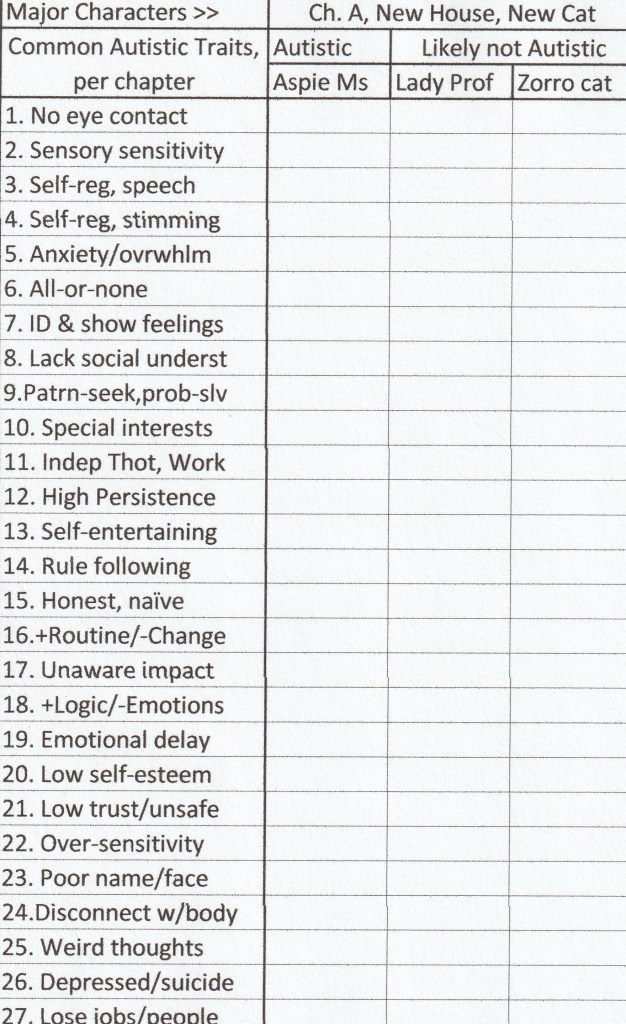
- To track the Autism characteristics that Aspie Mouse displays in each chapter of these “Adventures,” you might want to use a spreadsheet such as the one below or on the Aspie Mouse website. Aspie Mouse is always listed as the first character for each chapter in the spreadsheet.
- More ambitious readers are invited to do the same for other Autistic characters — none identified in this chapter — and even non-Autistic characters (in Ch. A, Lady Prof & Zorro).
- Particularly devoted readers may use + and – signs to indicate when a particular Autistic trait is shown positively, negatively or some of each.
- Which Autistic trait(s) shown in this chapter do you identify with? Do you see each trait as more positive, more negative or roughly balanced? Insert a column for yourself!
- Which Autistic traits shown by characters in this chapter are not traits you have, whether you’re Autistic or not?
A 2: In the first panel, Aspie Mouse mentions that his new home was recommended by his sister, but he can’t remember his sister’s name.
- What problems do you have in recognizing and/ or remembering people — their names, their faces, associating their faces with their names? If yes, what issues have happened as a result? If no, if you know such people, how compassionate are you toward them forgetting your name or even having trouble recognizing you?
- How good are you at “reading” facial expressions? Have you thought a facial expression meant one feeling, only to learn the person felt differently? Do you ever ask a person whose facial expressions you can’t “read” to tell you what they’re feeling? When do you explain your difficulty picking up facial expressions (if you do) and when don’t you? Why?
- How well do you notice and “read” non-facial body language, such as hand gestures, shoulders slumping, leaning forward vs. leaning back, crossing arms/ legs, etc.? Have you mistaken a body language cue for showing one feeling — or ignoring the clue entirely — and then learned it meant something different? Were you scolded for not picking it up? If you can’t read someone’s non-facial body language, do you ask what they’re feeling? If this is a concern, how do you try to get better information on another’s body language?
- What problems (if any) have you run into because your own facial expressions don’t seem to match how you’re feeling? “When (if you do) have you had times when others believe you “don’t feel anything,” yet you know you do, but have trouble showing it? Or are you so animated in your facial expressions that you have trouble hiding your feelings even when you wish you could?
A 3: The main theme of this chapter — and to a great extent this entire set of chapters — is that Aspie Mouse goes through life unaware of what others are really thinking about, and what they are trying to do in relationship to him. It’s what makes the events in each chapter funny — while illustrating the social misunderstandings that everyone with Autism faces daily, along with difficulty appreciating another’s point of view as different from “mine.” In real life, such misunderstandings often lead to bad feelings, accusations (you’re “stupid” or “ignorant” or “selfish” or “hurting on purpose”) and negative consequences. This and the next question set (A.4) try to help improve awareness of social impact, what others think of the lack of it, and how to make it clear the unawareness is not being mean on purpose.
- When Zorro’s human owner turns off the light to go to bed, Aspie Mouse decides to wake up the cat and “party.” Besides Aspie Mouse’s unawareness of the cat’s real agenda (to keep the house free of mice), do you believe Aspie Mouse’s behavior toward Zorro is mostly which of these: hostile, friendly, scheming, or some of each? Do you identify more with Aspie Mouse or more with Zorro in this chapter — or with each at different times?
- In the thought balloon in the last panel on page A.3, Aspie Mouse pushes down doubts about his plan to push Zorro into playing with him by asking himself, “How bad can it be to be impulsive?” Ask yourself — or if in a group, ask each member of the group — this same question.
- Aspie Mouse hurts Zorro physically. When does that seem to be on purpose, and when does he hurt (or even knock out) Zorro without meaning to? When have you physically hurt someone on purpose (biting or otherwise)? When have you hurt someone physically without meaning to?
- When have others hurt you? When did it seem intentional and when accidental? Did you ask? What consequences have resulted when you’ve hurt others or been hurt?
- Aspie Mouse gets Zorro in trouble with his human on several occasions in this chapter. Does he do that on purpose, or is Aspie Mouse unaware of what could happen to Zorro as a result of what his actions? What is Zorro’s point of view that Aspie Mouse is ignoring?
- When have you gotten someone in trouble? Was it on purpose or without meaning to? When has someone gotten you in trouble? Was it on purpose or without meaning to? What was the impact (consequence) of this or these situations on your relationship with that/ these other person(s)?
- Aspie Mouse says that human adults “get in the way of having fun.” Do you think that’s true at times? When has an adult stopped you from “having fun”? Was the stop justified? What is another way of looking at the situation — from the adult’s point of view? How much of the problem is that adults see or face the consequences of “fun” in a way kids (or Aspie Mouse) don’t? Is this a problem for you now? (Also see Q set A.7 below)
- Is being unaware of the results of one’s actions on others — as Aspie Mouse often seems to be — something you associate with Autism? Does that happen to you, or are you usually aware of what the result of your actions are on others?
- Continuing from A 3-7: Are you more aware of the “physical” result of something you did or said than you are of the “emotional” effect it had on others? How aware are you about the social consequences for you of something you said or did: before you said or did it? — after you said or did it?
- Do you think “those with Autism are very often unaware of others’ wants, feelings, reactions, and the importance of behaving in a socially acceptable way” is a stereotype –something people say about a group that doesn’t take into account that many individuals within the group don’t behave that way? How much do you keep the stereotype alive by being unaware of others’ wants, feelings, reactions, etc. yourself? What steps can you take to change how others see you if they see you this way: if it’s true for you? if it’s not?
- Following up from Question A.3-2: for you personally, or for each member of a group if you’re answering these questions as a group exercise — what works (if anything) to slow yourself down in order to be less impulsive? Why is it important to do that?
A 4: Aspie Mouse is constantly chattering and thinking of additional things, whether he’s alone or interacting with Zorro. He talks to Zorro, even though Zorro can’t understand his squeaks. Constant chattering (including dominating while speaking, making unexpected grunts and noises, and asking lots of questions) is one side of Autism, and fairly common, though not the image most people have of Autism. This is how Aspie Mouse is. In later chapters, other Autistic characters will mostly be silent.
- If you’re Autistic, are you mostly a chatterer, or mostly silent? Whether you have Autism or not, which “side” (almost always chattering vs. almost always silent) are you most familiar with? Which bothers you more? If it’s true that both sets of behaviors are hard-wired into those with Autism, and very difficult to moderate, would that make you more sympathetic toward both overly dramatic constant talkers/ question-askers, and also toward those who are silent and expressionless — including having more compassion with yourself?
- Are you a picky eater as Aspie Mouse says he is on pages A-2-3? In particular, can you eat the same foods for each meal day after day without quickly getting bored?
- What do you think Aspie Mouse is feeling when he says “What a spoiled cat…” in the last panel of page A-2. What’s another way to look at what’s happening from Zorro’s point of view? From Prof. Gonzalez’s point of view? Is this feeling Aspie Mouse has familiar to you, either because you’ve had it (perhaps toward a classmate or sibling or friend) and/ or you’ve seen that behavior in others towards you?
- When Aspie Mouse finally decides to wake Zorro up, he says he feels “giddy” and decides to ignore what that means. What are the consequences of ignoring that “giddy” feeling? When have you had such a feeling and ignored it, and caused trouble and/ or gotten in trouble as a result? Or have you been more often the victim of someone else ignoring when some idea they have that didn’t work out so well for you?
- Aspie Mouse chatters away as he keeps causing pain and trouble for Zorro. Do you talk more or talk less when you are especially anxious vs. other times? Do you use words to cover your feelings or your doubts? If not, what might you do instead?
A 5: On page 2, Aspie Mouse wonders why he can understand his new human lady’s words, yet he can’t understand other humans’ words. Why is this so? This mystery “teaser” question will be asked again at the end of Chapter H (in Volume II) as Question H-2. You should find it easier to answer after you’ve read Chapter B.
A 6: Prof. Gonzalez went from praising Zorro for what he did (whether or not he had anything to do with the absence of mice for 5 years) to immediately blaming Zorro when suddenly Aspie Mouse is causing chaos.
- Is Prof. Gonzalez being fair when she punishes Zorro, unaware that Aspie Mouse is really the one causing the breakage, etc.? Is she being just? Can you identify with Zorro being blamed for something he tried to stop, rather than start/ cause? Has that happened to you? Why do you find the situation funny — if you do? Is it likely or unlikely your own care-givers would change their opinion of you that quickly when chaos suddenly occurs, but you didn’t cause it?
- When have you been punished/ accused of doing something bad for which someone else, who had a much bigger role, didn’t get blamed? What did you do in response? Was it straightened out?
- Have you ever started something that got someone else in trouble more than you? How did you feel when that other person got in trouble? What did you do in response? Did it get straightened out?
- Aspie Mouse says that human adults “get in the way of having fun.” Do you think that’s true at times? When has an adult stopped you from “having fun”? Was the stop justified? What is another way of looking at the situation — from the adult’s point of view? How much of the problem is that adults see or face the consequences of “fun” in a way kids (or Aspie Mouse) don’t? Is this a problem for you now?
- Have you started doing something “fun” that others disapproved of, or which got you punished because of the bad things that resulted (property destroyed, others feeling bad, etc.)? Just on April Fool’s Day and/ or Halloween? Or are you someone who often finds yourself on the wrong end of others’ “fun,” which isn’t fun for you? Do you mostly try to avoid these situations?
- Have you ever felt so “wronged” that you were tempted to “run away from home” as Zorro did? Or did you have another reason to want to run away from home? If not, do you know someone who has either done so or told you they were seriously considering doing so?
- Do you wonder what happened to Zorro? Most cats who lose their home end up in a pet shelter and don’t get to live with another family. On the other hand, cats who go outdoors kill more than a billion birds a year. How does reading these last two statements affect your feelings about Zorro? Cats in general? Cats you know? Zorro’s fate will be resolved at the beginning of Chapter I (in Volume II).
A 7: Aspie Mouse, though a young adult mouse, really loves to play (especially with cats!). Most of the play involves what is sometimes called “imaginative play” — play from the mind, rather than “set” play, which would be using a board, designed card games or computer programs created by others — or a third type: organized team sports.
- How much do the adults in your life “play” — other than with their own kids or relatives’ and friends’ kids? Why or why not? In your experience, when adults play, is it more “imaginative” play, “set” play, or organized team sports? Is this ratio different from what you see kids do, or what you yourself do/ did pre-teen?
- What messages have you received from parents, teachers, etc. about whether or not (and/ or how often) adults should “play”? How about teenagers in high school? At what age do you think people should shift from imaginative play to “set” play (cards, board games, etc.) and team sports? Or do you believe there should be time for all three in all stages of life?
- Have you been told that there’s a certain point in growing up when you should mostly give up play to focus on preparing to grow up — to launch a career, marry & start a family, settle down, be responsible, etc. At what age should that be for YOU in your opinion?
- (Or) have you been told that being responsible doesn’t mean giving up “play” — that being responsible might make it easier to be able to continue playing? What do you think of these ideas — especially if you were raised to believe as per Question A 6-3 above?
- How much play do you allow yourself? Do you feel free to play, vs. having some guilt or shame? What do you like to do in play? Is it more likely to be by yourself, or with others in person, or with others online? How much of your play is “imaginative”? “Set”? Organized team sports?
- What impact do you believe watching violence on television and in many computer games — where the consequences of that violence (hospitalization, paralysis, traumatic brain injury, funerals, etc.) aren’t shown — has on kids hurting others or getting hurt when they play together?
A 8: (Similar to Question H 8) When the lady homeowner (Prof. Gonzalez) tells Aspie Mouse the impact he’s had on her life and Zorro’s, Aspie Mouse expresses shame, sadness and remorse.
- Prof. Gonzalez — the human resident in his new home — confronts Aspie Mouse after her cat Zorro runs away (p. A-11), but then, seeing his response, trusts Aspie Mouse more as a result. What about Aspie Mouse’s non-verbal responses to her seems Autistic in nature? What about his non-verbal responses are uncommon for those with Autism?
- (Cont’d from A 8-1): The Author believes Prof. Gonzalez would have dismissed Aspie Mouse as just another mouse that couldn’t understand human words if he didn’t show at least one atypical Autistic non-verbal response. Why do you think the Author believes that? Explain why those with Autism whose non-verbal response to a verbal confrontation is more typically fully Autistic would have trouble getting others to trust and understand them. Is this a problem you have?
- Is Aspie Mouse’s situation — doing or saying things that seem fun or innocent to you, only to learn afterwards that your words and/ or behavior have had a really bad effect on others; that you’re “disruptive,” and you lose trust with friends, co-workers and/ or family members– familiar to you? Have you done it a lot, sometimes or rarely? If not, do you know someone with Autism with disruptive words/ behaviors often enough to notice it?
- When this situation happens to you (if it does) — you’re seen as disruptive, untrustworthy and/ or someone who makes situations worse — what feelings come up for you? If you don’t believe you do this often, what feelings come up when someone else behaves in such a disruptive way?
- Does this sort of behavior — whether you’re the one doing it, or you’re one who witnesses it — cause you anxiety? Or increase anxiety if you know you’re usually anxious? What happens to you when your anxiety increases — do you tend toward acting out angry? run away or feel like running away? freeze? Do you make good decisions when this happens?
- Are you one of those for whom this pattern happens so often you live in terror not knowing when it will happen again? (See A 6-9 & 10 below for possible remedies.)
- Are you able to tell others that you do or say the things you do because you have Autism, and not because you are being mean or ignoring others’ feelings on purpose? If not, what stops you?
- What changes in behavior have you tried to avoid having this happen again to you (either as the one who is disruptive or the one who hates seeing it happen in another)? What strategies might you employ to make this behavior pattern less likely to repeat?
- Do you meditate? Count to 10? Wait until you get feedback before you say something or do something that you may think harmless, but in your experience may not be seen that way by others? Might these be helpful responses to try, instead of “going crazy”?
 Aspie Mouse Blog