The Adventures of ASPIE MOUSE started as a blog in 2019, with the intention of being developed into a Graphic Novel for publication in 2021. It was divided into two volumes when it became too big for a standard-sized graphic novel and was taking far longer to complete than anticipated. At last, Volume I (Chapters Pre-A, A, B, C, D & E) will be formally published with a 2026 copyright, with Volume II likely a year or so later.
Aspie Mouse is a character this author created when I was 12, only resurrecting decades later when I realized he’d been an Autistic alter ego for me all along. Back then — and for decades afterwards — I knew nothing about Autism, nor that I had it.
Thanks to my son’s pre-DSM V diagnosis of Asperger’s — which made me finally realize I too have always had Autism, albeit less pronounced — I decided to dust off that old comic character, and create a new set of adventures for Aspie Mouse to give pre-teens, teens & young adults with Autism a positive role model in this alter ego of mine. As the graphic novel developed, I added additional Autistic characters — rodent, feline and human — presenting other aspects of Autism besides those Aspie Mouse manifests.
Originally intended as a 250-page book of 15 chapters– about average for graphic novels — the chapters’ length kept creeping up as I revised the initial chapters and wrote new ones. I also decided to add chapter notes and questions for thought/ discussion. So I reduced the number of projected chapters from 15 to 10. Thus the first chapter I wrote for this work (Ch. J) became Ch. H (9th of 10). Then, a reviewer suggested I make this first-written chapter the first “warm-up” chapter. I agreed, and thus re-lettered it as Ch. A. As there was already a Ch. A — a prologue disguised as a chapter — that previous Ch. A became Ch. Pre-A. Then, to avoid a “hole” in the chapter sequence — since Ch. H’s material fits sequentially between Ch’s. G & I, I chose to repeat Ch. A’s material as Ch. H (again) — where it belongs. Ch. A is thus a “flashback, while Ch. B remains the “real” first chapter, as was always intended. To make Ch. A’s repeated material in Ch. H worth re-reading, a new sub-plot was added, doubling Ch. H’s length vs. Ch. A.
While finishing up a complete draft of all 10 chapters (Pre-A to I) after four years of work, I realized that my original intention for the Adventures of Aspie Mouse to be a single print volume of 250 pages was unrealistic — even if the notes & questions were moved to “blog only.” The length for the printed version with everything included would have ended up over 500 pages and take up to two additional years to finish! So, this author decided to break this material up into two separate volumes: Vol. I getting Ch. Pre-A and Ch’s. A-E, with Vol. II following with Ch’s. F-J. In order for each of two volumes to have five action chapters — as the Prologue Ch. Pre-A was the original 10th Chapter — a new Chapter J needed to be added.
Once both volumes are published separately — adding Ch. J to Volume II will likely delay it to 2027 or 8 vs. 2026 for Volume I — they may then be combined into a single hardback, if there’s market support. My main regret in releasing these Adventures as two volumes is that it’s one continuing story. Each chapter — starting with Ch. B — builds on those before it. As a result, Ch. A and its “twin” Ch. H end up in separate volumes; same is true for Ch. G’s re-introduction of characters first presented in Chapters B-E. And Ch. I’s side plot of occurring during the early months of the COVID pandemic, which already seems quaintly historic, won’t come out for another year or two! All good arguments for that combined hardback!
It should be worth the delay. The new Ch. J introduces two new mouse characters with Autism — one with Profound Autism; the other, his brilliant, irony-loving, savvy sister. That should allow an even larger portion of the Autism Community to see itself represented positively.
Volume II, particularly the last three chapters, including the new Ch. J, will also include more socially relevant situations: prejudice around class; those who “look different,” and Earth’s survival due to climate change come up toward the end of Vol. II. However, as in the rest of these Adventures, these are all background situations to enhance that chapter’s general interest.
I continue to avoid politics and the “culture wars,” taking as neutral a stance as I can on these potentially divisive social issues — to avoid being accused of being “too liberal” or “too conservative.” If I hear equal frustration from both sides, I’ve done my job well! I focus instead on how the characters with Autism handle themselves both individually and collectively to show their how they use their positive Autistic characteristics to solve serious problems.
In the blog, the latest chapter posted or substantially revised is placed first, then Front Matter, then each of the other 11 chapters (including the Prologue Pre-A) in sequence. Ignore blue “Posted” dates listed on the “Chapters” page of the blog — they’re manipulated to keep the Chapters in their intended order. Look to dates shown in the Chapter headings for what’s actually “latest.”
As noted elsewhere in this blog, once either volume (I or II) of this graphic novel is published, completed chapters will be removed from this blog, except for Ch. Pre-A (or Pre-F) & the first page/ few pages of each of the “action” chapters in that volume. Once all 10 “action” chapters are complete, new chapters for any additional sequel will post to the blog as they are developed — until they too get published.
Any artist (especially one on the Autism Spectrum) who thinks s/he can improve upon the artwork in this blog is invited to contact the author (chris@aspiemouse.com) ASAP about submitting samples, potential compensation, etc.
Thanks for all the feedback I’ve received! Art upgrades; moving Chapter H (ex-J) material up to create a new Chapter A; paring down dialog — are among many suggestions made so far that have been implemented to some extent. I encourage you to keep them coming, even post-publication! It’s so easy for me as an author — when I get excited by an idea — to lose perspective as to how it might “land” on others. So I’ve learned I need feedback (from other wordy Aspie’s like me, as well as from those who get overwhelmed by too many words; and also from Neurotypicals trying to learn more about Autism). Having learned not to take criticism personally, I WELCOME ALL FEEDBACK — especially as to my IMPACT on others! I’m also learning to become a witness and not a judge of my own behavior and the behavior/ words of others (a Jungian concept that I’d heard for years before I “got” it). It reduces my feelings of anxiety, anger and shame, allowing me to learn from what I’ve done and move on –“let go” of what’s best not to keep holding onto, such as negative judgments — vs. getting “stuck.”
If I don’t implement one or any of your suggestions, you weren’t ignored; nor did I reject you as a person. When I was a textbook acquisitions editor, I observed that when my most successful academic authors were given “peer reviews,” they were superior at separating wheat from chaff vs. my less-successful authors. They knew what fit — or even improved upon — their vision, while passing on other well-intended reviewer suggestions that didn’t. As 12-step programs suggest, “Take what you like and leave the rest!” I also observed that less successful authors often (a) ignored reviewer suggestions, (b) were unable to implement them, or (c) tried to appease reviewers by doing everything they suggested, leading to an unwieldy mess. My intention is to do what will most benefit of my newly discovered/ adopted “tribe,” fellow “Aspies!”
For more explanation of the author’s intent in writing The Adventures of ASPIE MOUSE, read past the Table of Contents below to the “Author’s Prologue”; also Chapter Pre-A (a different Prologue disguised as a chapter), and the notes after the early chapters (A-C especially), and in the section of the blog entitled “About Aspie Mouse Blog.
January 20, 2026
The following is to be added to Ch. Pre-F or the Prologue to Vol. II:
What’s current in society — especially events with direct impact on those with Autism — is covered within chapters, though not defined by a particular time period (except for Chapter I, which occurs early in the COVID pandemic, and Ch. J, now or in the very near future as Climate Change continues to worsen). Thus, Chapter E (Therapy Dog…) touches on race, albeit modestly, along with loneliness and the use of therapy animals. Race, social class and “difference” issues come up again in Ch’s. G, H & I (and likely J) in Volume II, but without “taking sides.” In Ch. H, Aspie Mouse has uncomfortable interactions with four mouse brothers who initially don’t trust him; Ch. H also confronts bullying. Ch. F (Klumsy Kat) features a character with “multiple disabilities (challenges),” along with issues around separation/ being “sent away.” While Ch. I is set during the early days of the Covid-19 pandemic, the focus is on Aspie Mouse’s interaction with zoo animals — especially the often awkward social interactions those with Autism often have with peers (which for him is other rodents) — in that respect, building on the recent peer interactions in Ch. H. Ch. J will have climate change issues as a backdrop for introducing two new Autistic characters. But once again, how much climate change is human-caused is purposely left for a reader to decide — culture war material is not part of the curriculum!
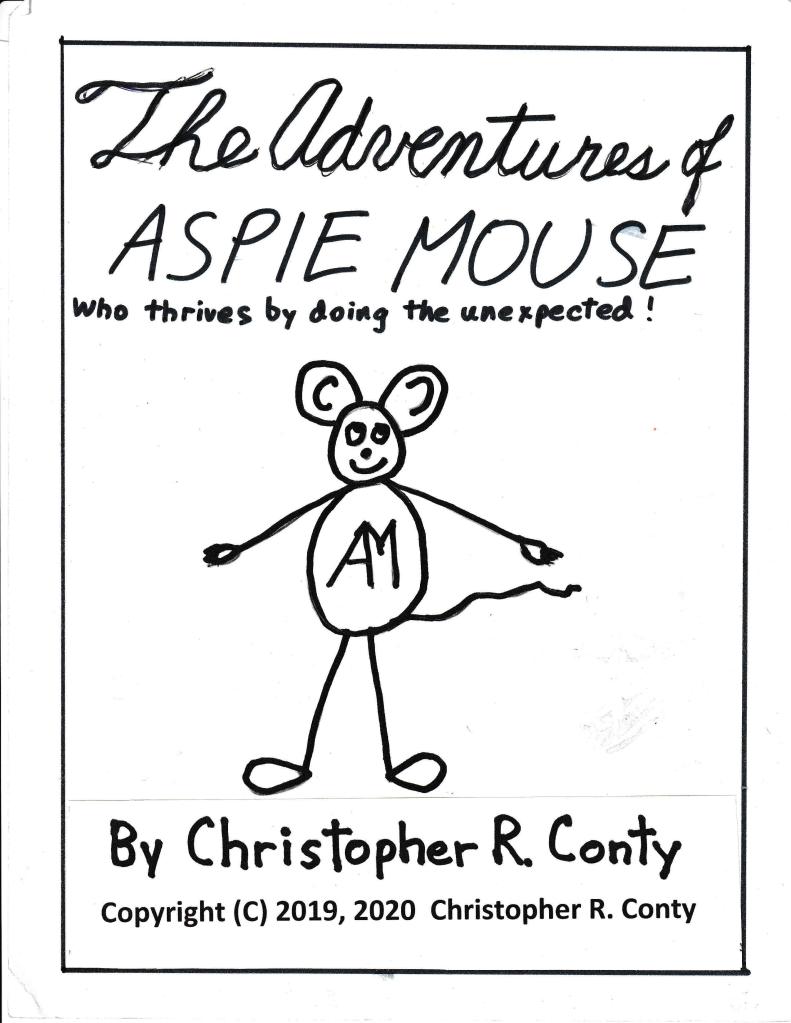

TABLE OF CONTENTS of the Chapters in each of three Volumes of the Adventures of Aspie Mouse
i-viii Front Matter: Title Page; Dedication & Copyright Page; Table of Contents & Prologue I
Volume I (Chapters Pre-A through E)
34 pp. Chapter Pre-A: Introducing Aspie Mouse (Prologue II – 4/20, 4/22, again 8/24, 2/26)
12 pp. Chapter A: A New House, a New Cat (Final revision posted 7/31/2022)
26 pp. Chapter B: Leaving the Nest for “MIT” (Final revision posted 8/31/2022)
30 pp. Chapter C: There Goes the Smartest Cat That Ever Lived (Orig. 10/19; Final 4/9/23)
24 pp. Chapter D: X is for Exterminator (Posted fully revised 10.7.20; final final 7/1/23)
20 pp. Chapter E: Therapy Dog Needs Therapy (1st fully posted12.31.20; final revision 1/18/24)
26 pp. “Preview pages” from Vol. II Chapters F-J (pp. F-1,3,8,10,13; G-1,7,11,19,29; H-3,5,9; I-1,4,9,16,22,26,27; J-1,2,?,?,?,?
Appendix: Chapter Notes & Questions for Thought/ Discussion, References (Ch’s F-J) – Included after panels in Chapters in blog, at back of each volume in print version). 170 pp. prior
Volume II (Chapters F-J with a likely new short Pre-F)
i-viii. Front Matter: Title Page; Dedication & Copyright Page; Table of Contents & Prologue II
12 pp. Chapter Pre-F: Summarizing Ch’s Pre-A to E from Volume I & applying Pre-A to Vol. II
24 pp. Chapter F: Klumsy Kat, But Only When Anxious (pp 1,2 8.20.20; done 1.28.21)
36 pp. Chapter G: Parade of Visitors: Feline, Canine, Rodentine & Humine (fully posted 4.15.21)
24 pp. Chapter H: New House, New Cat, New “Nay”bors (Posted 1/19 (J), Rvsd as H, 10.27.20; see A)
34 pp. Chapter I: At the Zoo During a Pandemic (1st 6 pp 5.18.20; full draft 34 pp., 6.6.21)
32 est. Chapter J: Our ASD Friends Excel, Tackling Shelter, Survival for Profound, Climate Change Disasters – Proposed (2-1/2 pp. done, just p. J1 in the blog.)
Appendix: Chapter Notes & Questions for Thought/ Discussion, References (Ch’s F-J) – Included after panels in Chapters in blog, at back of each volume in print version).
Author’s Prologue (Updated 12/4/2025)
It’s not normal for an Author to write a Foreword for one’s own book. Oops! In the Autism community, “normal” isn’t used for people. In 12-step recovery groups (AA, Al-Anon, etc.), “normal is a cycle on a washing machine.” Okay, let me start again.
It’s not typical — or usual — for an Author to write a Foreword for one’s own book. If typical or usual are okay words to use to describe people (as in Neurotypical), vs. normal, may we also use their opposites, atypical and unusual? I know I’ve been called “unusual.” I certainly prefer that to being called “weird” — or worse! The words used around Autism are a source of disagreement, as Aspie Mouse himself will explain in Chapter Pre-A, which follows.
Instead of calling this a Foreword, I’m calling it a Prologue. Next comes Chapter Pre-A, the first chapter with panels with drawings, like a comic book or graphic novel. Chapter Pre-A is, however, really a second prologue masquerading as a chapter. While forewords and prologues are not common in contemporary fiction, this graphic novel is designed as much as a teaching tool as it is entertainment. Thus, orienting parents, teachers and other caregivers in advance is useful. I’d certainly not call this a Preface — sounds too much like a textbook!
Why two prologues when other graphic novels have none? Simple answer: I wanted my alter ego, Aspie Mouse, to present one of them. Deeper answer: as I continue to evolve in understanding the impact my Autistic-influenced behaviors have on others, I modify finished chapters to incorporate these new learnings. In turn, Aspie Mouse and other Autistic characters evolve in how they behave.
One reason it’s taken seven years to write this work is that I keep adding these new “aha’s.” For instance, I’ve recently become aware how, as a boy, I developed a “showman persona” — showing off, talking loudly using many words, hogging center stage. Then, when I created Aspie Mouse, he was also a showman. That made me realize I needed to both soften that part of him and to balance his energy with by introducing two additional characters in a new Chapter J (in Volume II) who fall elsewhere “on the Autism Spectrum.” Aspie Mouse and I can use these two prologues to explain how these new insights are incorporated, without requiring additional changes to Chapters A-E, delaying Volume I’s publication even longer. (Another reason for taking so long to finish is that I have ADHD as well as Autism; and Russell Barkley defines ADHD as “failure to sustain effort to reach a goal.”)
That leads nicely to another unusual (Autistic?) element of this work: chapters are lettered A to E in this Volume I and then F to J in Volume II. Why letters, not numbers? Just felt right at the time! Maybe it’s the rebel in me fighting against the Neurotypical system — the system that punishes students who have Autism in math classes. How? It’s not enough to come up with the right answer; students must show the steps. But often those with Autism can’t: their conscious mind isn’t aware how they get the right answer — they just do!
Whether you can relate to what I’ve said so far, or you can’t, you’re in the right place. The title of these two volumes could as easily be, “Adventures in Autism, Featuring Aspie Mouse and Friends,” because while Aspie Mouse is the star, there are many supporting characters — rodent, feline, canine and human — several of whom also have Autism.
Overview:
The Adventures of ASPIE MOUSE is about an Autistic mouse who thrives — not just survives — by being himself.
Aspie Mouse and other characters with Autistic traits show how those with Autism can succeed in a Neurotypically dominant world. They maximize their Autistic positives, such as problem-solving, pattern-seeking, intuition, creativity, curiosity, rule-following, intense focus and following their own drummer.
They also model how to prevent and/ or get through periods of dysregulation that occur as reactions to behaviors and comments from other people — or even from one’s own actions that don’t work out as expected. Dysregulation leads to meltdowns and low self-esteem/ negative self-talk, which all too often prevent those with Autism from leading the rich and rewarding life all people deserve, in which the gifts from their unique way of thinking are celebrated.
Aspie Mouse first appeared as Stupid Mouse when this author was 12 — in a hand-written single copy 16-page comic book series produced monthly for a year and-a-half. I knew nothing about Autism, nor that I had it. Decades later — thanks to my son’s (pre-DSM 5) diagnosis of Asperger’s* (see Pre-A, p. 6 re the DSM), when I realized I too have always had Autism, albeit less pronounced — I decided to dust off that old alter ego comic character. I am giving him a new more appropriate name, Aspie Mouse, and creating a new set of adventures for him to give pre-teens, teens & young adults with Autism a positive role model of someone like them and me — but with more confidence in his identity as having Autism and in using his Autistic strengths to succeed in a Neurotypical world than I had as a youth, young adult, etc.
The Adventures of ASPIE MOUSE started as a blog in 2019, with the intention of being developed into a 250-page 15 chapter Graphic Novel for publication in 2021. Six years later, it’s been divided into two volumes of some 250 pages each. It grew too long for a standard-sized paperback graphic novel. It was also taking much longer to complete than anticipated as new features, plot enrichments, and notes and questions were added to each chapter. Volume I (Chapters Pre-A, A, B, C, D & E) is publishing with a 2026 copyright, with Volume II anticipated to come out a year or two afterwards.
Note to school boards and librarians:
This author has a dilemma.
On the one hand, I’m committed to make sure every pre-teen, teen and young adult has access to The Adventures of ASPIE MOUSE. Whether they’re Autistic or not, I want them to experience characters with Autism (mice, cats, humans) that maximize their gifts — modeling the key positive message that this work offers: Lean on the positive traits inherent in your Autism, and apply these positive traits — along with new coping strategies — to defuse situations which in the past have led to bad outcomes, such as meltdowns. The best way to achieve such widespread availability would probably be to avoid every “culture wars” issue.
On the other hand, because young people with Autism don’t care much about trying to “fit in” with others their age, they are more likely than their peers to ask blunt awkward questions and “try out” non-conforming beliefs and lifestyles in politics, religion and sex. These are topics that neurotypicals — especially those brought up in families and communities with conservative values — learn to avoid to stay connected with others in their family, church and school. If those with Autism don’t see themselves represented and their questions and concerns being raised, they’ll tune out and ignore this work’s positivity. They’ll miss out on such universally approved concepts such as: Your life has value, and may even literally be a life-saver. These Adventures counter a common belief — by many people beyond those with Autism — that they’re “not good enough,” “not worthy” as a human being, etc. Yet if this work confronts culture war topics directly, this work won’t be available in school and community libraries in conservative states. And if these issues aren’t addressed at all, school and community libraries in liberal states may join their students in dismissing this work as irrelevant.
Therefore, I’ve made choices on what I present, especially in the action chapter comic-style panels of Chapters A-E (Vol. I), that should not trigger a campaign for this work to be “banned” by any local or school library.
This author’s solution?
- Aspie Mouse and the other characters deal with these issues of concern to today’s youths without taking sides. It’s a tricky dance, sure!
- Almost none of what may be even mildly controversial is found in Volume I (Ch’s. A-E). By saving most of the more challenging issues to Chapters F-J (Vol. II), Volume I should be safe to read anywhere.
- When issues are addressed, they’re considered as matters of fact — just how it is. Each character needs to find their own way to use their Autistic strengths to overcome their challenges. Greater implications for society are avoided.
- Finally, nothing remotely controversial involves the human characters in these volumes — only the animals.
More details as to how I’ve chosen to stay neutral, yet let those with Autism “see themselves”:
- The two human families introduced model traditional family values: both are heterosexual church-attending Christian intact couples, each with two children. They’re modeled on actual families I grew up knowing (substituting Synagogue for church in one instance). There is no nudity or discussion of sex by the humans, nor are any particular religious beliefs mentioned. The humans lead faith-based lives without specifics mentioned.
- The animals are first of all, not anatomically correct: female mice are shown with eyelashes and bows). The animals introduced are, for the most part. “young adults,” many with Autism, not yet in committed relationships. Because those with Autism are slow to mature emotionally, they are modeling a wise autistic strategy by delaying intimacy until they are ready. When one neurotypical female mouse persists in trying to kiss and hug Aspie Mouse, he keeps resisting as his moral compass tells him it isn’t right. Implied is that in the future — like me — they may belatedly choose a traditional monogamous relationship, or stay safely single (like Temple Grandin) or maybe something else — but any other options aren’t discussed.
- I avoid incendiary words (DEI, Woke, systemic racism, affirmative action, gender non-conforming, gender-affirming, my pronouns are…, LGBTQ+, white privilege, politically correct, etc.). The only issue related to any of these words that comes up (for animals, not human characters, and not until Volume II) is questioning one’s sex or sexual attraction (never using the word “sex”). The message presented is that having such thoughts is O.K. — those with Autism often have anti-social thoughts they can’t get rid of — but acting on thoughts that are out of bounds is never a good idea.
- The use of “they/ them” instead of the traditional “he/she” for referring to individuals of unknown gender, is insisted upon by publishers. I avoid doing so within the action chapter panels (Chapters A-E in Vol. I, and F-J in Vol. II) for readers, and minimize its use in the parent/teacher materials (this Prologue — I do it once in the paragraph preceding this bullet list — Chapter Pre-A and the Chapter Notes). Another terminology decision: “those with Autism” or “have Autism” has replaced “(Aspie Mouse) is Autistic,” because of consensus by the community of those with Autism that, having other personality traits and gifts unrelated to their Autism, they shouldn’t be defined by a diagnosis.
- In this graphic novel, characters with Autism often overcome their challenges by “pulling themselves up by their own bootstraps” (individual effort, a traditional conservative virtue) — given those with Autism prefer acting alone anyway. However, there are times when “working together with others to achieve a common goal” (collaboration, a traditional liberal value) — shows how group effort produces better results than any individual could do alone. Showing examples of when, where and how to collaborate is modeled as a trait worth cultivating — despite teamwork being a traditional struggle for those with Autism.
- While one of the two human families featured is Black — with the father Claude an immigrant — neither race nor immigration among humans gets more than token mention. The main “race” issue concerns gray vs. brown vs. white mice: it’s handled in such a way that it’s clear that the problem isn’t about prejudice based on color, but other factors, such as class and nepotism. Also, while Claude is a Haitian immigrant, his parents visit him here, and then return to Haiti: despite the dangers, with no anti-U.S. bias; it’s just “home.”
Author’s Background Leading to The Adventures of ASP|E MOUSE
I’d started drawing comic books to give away to my friends at age five, after seeing a “Looney Tunes” comic book at a barber shop. I went home and used the same format: five pages per story, 32 inside pages, a 4-page cover, with all my own characters and plots. In Looney Tunes, I got upset that Tweety always bested Sylvester! In hindsight, I recognized that Sylvester — like me — was socially clueless. At age 12, I created a character, who — like Tweety — was a small, weak prey animal — albeit a mouse, not a bird. Though Stupid Mouse had his own version of confidence that he’d stay alive — similar again to Tweety — in one key way he was more like Sylvester: Stupid Mouse was also socially clueless! His favorite activity was “playing with cats” — every mouse’s #1 predator. That’s why I called him Stupid Mouse: any outside viewer — mouse, cat or human — would think he had to be stupid, crazy or have a death wish if he liked to play with cats! But even when the cats were socially aware, he’d always escape — not by being clever — but by zigging when a cat zagged — in other words, by doing the unexpected. Only years later did I realize this behavior wasn’t stupid — it was Neuro-divergent, or Autistic.
Not being a particularly good artist — and ignorant about Autism — I put drawing comics aside in high school for more “serious” pursuits. My father suggested I have a profession — such as law, medicine, engineer or teacher; then, if I wanted to be a writer, or an actor, or a public speaker, I’d have a profession to fall back on. He meant well, and if I’d been Neurotypical, he may have been right. But I just couldn’t do it! I never pursued a post-college professional degree — one of only 16% of my graduating class at Yale NOT to obtain an advanced degree! After a false start in insurance (not many Autistic or creative types there), I had a successful college textbook publishing career for two decades — as long as I was willing to relocate and travel a lot for work. One reason it worked out is that my “customers” as sales rep and editor — college professors — often also had Autism and/ or ADHD. Even when they didn’t, they appreciated my intelligence, superior product knowledge, honesty (I wouldn’t promote a book I didn’t think would fit their needs, no matter how “hot”) and were tolerant (as teachers) of a wide range of personality types, including mine.
In retrospect, finding that career in publishing was beneficial to my future, because the quirky way I got paid (modest salary, but some big bonuses) allowed me to save money, which really helped when things went sour in my late 40’s. After my publishing career cratered — due to constant mergers and office politics I couldn’t navigate — my self-esteem — never as high as my resume implied — plummeted.
I’d been placed in therapy in Third Grade, for “acting out” and “being a wee bit too sensitive.” I continued therapy and self-help programs throughout my life. The one that led to life-altering changes was the ManKind Project (mkp.org). What led to learning about my own Autism was having my son diagnosed with Asperger’s — just before the DSM 5 abolished the term in favor of saying we’re all on one big Autism Spectrum. See Ch. Pre-A for more on the DSM 5. It hadn’t occurred to me that being overly dramatic, talking a lot, asking many questions and being a “word” savant is just as Autistic as low affect, speaking in a monotone, being a computer genius and showing no facial expression or reaction when others are crying, shouting, laughing or scared.
After understanding that like my son I am on the Autism Spectrum, I decided to write this graphic novel as a way to give back to my newly discovered clan. I want to show younger Autistic folks how they can thrive, not just survive. Also, I want to show ways to gain respect — not just criticism — for doing the “unexpected,” while avoiding the truly “unacceptable” — by developing a filter to not express all one’s thoughts and to minimize dysregulation from a clogged up executive function.
So I brought back that mouse — now Aspie Mouse — to show that he’s proud to be Autistic, because it’s just who he is. I’m taking even the most negative parts of Autism — anxiety, social cluelessness, trouble identifying feelings, black and white thinking, and meltdowns — and show how the negative aspects can be reduced. Even the most negative-seeming trait can have a positive side. The key is two-fold: (1) a willingness to grow and change; (2) a willingness to request and receive feedback, yet not take it personally. As Aspie Mouse goes through his life pursuing his “special interests” (ingenuity with objects; great Internet skills; and above all, “playing with cats”), I hope he encourages others with Autism to respect their ability to see connections/ networks that others miss, and find true “out-of-the-box” solutions to problems that leave others muttering, “how’d you DO that?” I know who Aspie Mouse is, because I finally know who I am! Once I started writing, the ideas just flowed — no writer’s block! I was engaged in two related passions I’d buried: a great child-like imagination to express things in words appropriate to a comic book — in that sense, I never really “grew up” — and an ability to translate between the Neurotypical and Neuro-diverse worlds.
Hero? Super-hero? Neither? Special Interest — Suicidal?
As I looked over my earlier Stupid Mouse comic books, I soon realized that while the character — same personality, likes and dislikes — is just as relevant today as he was decades ago, the plots of the earlier comic books were too short — no more than five pages — and a bit too outlandish (flying to the South Pole on the back of an eagle, etc.). I found one plot from the original series worth keeping and expanding (Ch. D, “X is for Exterminator”). Otherwise, I decided it would be better to write new situations in the style of the earlier comic — except now Aspie Mouse is without the “superhero” powers I’d given Stupid Mouse that would be associated with stupidity — such as a hard head that steel would bounce off; or a resistance to being poisoned.
In these new “Adventures,” Aspie Mouse is seen by others as a “hero” given the many times he “saves the day.” However, he refuses to see himself that way. He is just being himself. I know most Autistic kids are really into superheroes! Yet I felt Aspie Mouse succeeding while NOT having super-powers (other than his Autism) would have more of a positive impact: “If he can do THAT, maybe I can do…!” The author believes, based on his own experience, that everyone with Autism can live a successful life on their own terms if they learn how to harness their special talents, while working to minimize the negative impact their deficits often create via dysregulation — especially if they ask for and then accept help.
A word on Aspie Mouse’s “special interest” of playing with cats. Of course the cats aren’t playing — with the exception of KK in Vol. II– but trying to kill him! So how does he survive having such a perilous “special interest?” Just as “Stupid Mouse” did decades ago! Aspie Mouse zags when the cats expect him to zig! So he’ll unexpectedly stoop down to get a crumb off the floor while two cats are chasing him; the cats crash into each other and knock each other out! Aspie Mouse then gets up, scratches his head and says, “Wow! Cats sure sleep all the time!”
Despite being really smart, clever and innovative, he takes everything at face value (a frequent Autistic trait, often associated with honesty/ bluntness/ naivete)– literally. Even when others tell Aspie Mouse he’s being too literal, he thinks they’re talking about him reading a lot! He also has no “filter.” He says whatever pops into his head. His dilemmas are often of his own making, and readers are likely to see what he’s missing in social interactions before he sees it. While Aspie Mouse never evolves to realize he’s too literal, he does gain more awareness about Autism as the work proceeds, especially in Volume II.
Yes, Aspie Mouse and other Autistic characters get into certain awkward (or worse) situations due to their Autistic limitations. Also, their poor executive function and low processing speed robs them of access to their learned resources– often at the worst times! On the other hand, their unique positive Autistic traits get them out of trouble, at least once they learn how to keep their anxiety at an “excitement” level, vs. a “paralyzing” or “freeze” level (explained in more detail in the notes for Chapter C).
Throughout this graphic novel, 27 characteristics of Autism (admittedly an arbitrary number) are demonstrated by Aspie Mouse and other Autistic characters, with the emphasis placed on the positive side of each. Most of the Preface (Ch. Pre-A) is devoted to analyzing the 27 traits and how indeed they may be positive.
The 27 traits are rarely mentioned directly within the panels of the 10 action chapters (A-E in Vol. I; F-J in Vol. II), so unless Ch. Pre-A or chapter notes/ questions are assigned reading, the “action” chapters can be read as entertainment — while rooting for one or more Autistic characters. The less this work looks like a “textbook,” the more likely it’ll be picked up and read for “fun.” That’s why the panels of all chapters run consecutively without the questions and notes: each purposely has an even number of pages, so the end of one chapter on an “even” page faces the start of the next chapter on an “odd” page (except for the “previews” of Vol. II chapters F-J that appear after Ch. E of Vol. I).
While the target age for this graphic novel is 10-15 — as for similar graphic novels — older teens and young adults have responded well to the blog. Not surprising, as the emotional age of those on the Autism Spectrum is generally 2/3 to 3/4 of their chronological age.
Chapters A through J have “Notes” and “Questions for Discussion/ Reflection.” A good “sample” chapter illustrating how these chapters grew as they were written is Chapter D, “X is for Exterminator.” Starting off at 8 pages, it expanded to 24 by its fourth draft.
What’s current in society — especially events with direct impact on those with Autism — is covered within chapters, though not defined by a particular time period, except for the last two chapters of Volume II (I & J). For instance (Ch. E, Vol. I, Therapy Dog…) touches on race — mostly just acknowledging differences — along with loneliness and the use of therapy animals.
Volume II gets deeper into issues around Race, social class and “difference” — again, at a neutral, simple level of acknowledging differences, not taking sides. Thus, those who believe in having a color-blind society and those who believe in a need for affirmative action can each find support for their point of view in the same panels. In Ch. H, Aspie Mouse has uncomfortable interactions with four mouse brothers who initially don’t trust him, but it’s as much that he’s unfamiliar, “not family” and has a different social background. Ch. H also confronts bullying. Ch. F (Klumsy Kat) features a character with “multiple disabilities (challenges),” along with issues around separation/ being “sent away.” While Ch. I is set during the early days of the Covid-19 pandemic, the focus is on Aspie Mouse’s interaction with zoo animals. His interactions with other rodents at the zoo often mirror the awkward social interactions those with Autism often have with peers. Ch. J will have climate change issues as a backdrop for introducing two new Autistic characters. How much of climate change is human-caused is left for readers to decide. It’s frustrating for this author to stay neutral in most culture wars issues, as I certainly have strong opinions (typical of Autism), but my goal to help as many young people with Autism is paramount. So the panels of this work remain neutral.
I hope I’m able to do what the target audience needs. I’m not writing this graphic novel for fame or money (though given my love for being on center stage, and after all the hours I put in, I won’t object to either). Still, I continue to ask anyone reading this graphic novel, “What’s the impact of my behavior or words on YOU?” Asking that question has been such a gift for me in my marriage and elsewhere in my life. Here I do it to gain the greatest benefit for my newly discovered/ adopted “tribe,” fellow “Aspies!”*
February 21, 2025, Christopher R. Conty
*Aspie/ Asperger’s are controversial words. See Ch. Pre-A, pp. 6-7 for some limits and rationales for their use.
iii -iv
 Aspie Mouse Blog
Wow… the chapter looks interesting. I hope the comics is interactive and relatable.
LikeLike